Wednesday, January 30, 2019

A GUIDE TO ADJUST BINOCULARS


BACKGROUND

Watching nature through Binoculars is a rewarding experience. Fascinating views, flora, and fauna from distance, binoculars perceive those scenes better than the normal sight can do. That's why it is important to ensure optic reliability, knowing its parts and essential adjustment would make the instrument function clearly.

I. PARTS OF BINOCULARS


PHOTO ILLUSTRATION: PARTS OF BINOCULARS

II. ADJUSTMENT PROCEDURE

A. ADJUST THE EYECUPS (twist up-twist out)

For non-eyeglass user, twist up the EYECUPS


For eyeglass user, keep the EYECUPS retracted


B. ADJUST THE DISTANCE OF EYEPIECE LENS

Hold the binoculars with both hands, spot a distant object while carefully moving the BARREL downward and upward, until you aligned the EYEPIECE LENS with your interpupillary distance


C. ADJUST THE SHARPNESS OF LENS

Close your right eye, spot an object through the left eyepiece with your left eye, and rotate the FOCUS RING until you get a sharp image


Close your left eye, spot the same object through the right eyepiece with your right eye, and rotate the DIOPTER RING until you get a sharp image


D. ADJUST THE FOCUS RING

After adjusting the DIOPTER RING, you no longer need to use it. Instead, rotate the FOCUS RING - to get a sharp image - whenever you spot an object


--- ENJOY WATCHING --- :)

Tuesday, September 18, 2018

Guided Bird Watching with Wild Bird Club of the Philippines, in LPPCHEA

Guided Bird Watching with Wild Bird Club of the Philippines, in LPPCHEA
By: Ramon Q. Gayas Jr. (Ser Montaineer)

AT THE MARKER OF LPPCHEA
One year ago, I joined the Wild Bird Club of the Philippines’ (WBCP) Guided Bird Watching trip in U.P Diliman. It was a nice experience that enabled me to see birds like the White-collared Kingfisher and Black-naped oriole for the first time. I’ve made to continue this recreation after, and I would say I am now enjoying it evenly like how I indulge to my other outdoor activities. Sometimes, I do DIY bird watching and practice bird photography in our backyard, nature parks, commercial gardens and some woodlands near to my workplace. As I am getting more interested about birds, I joined the club again on their Guided Bird Watching event last September 09, 2018, at the Las Pinas-Paranaque Critical Habitat and Ecotourism Area (LPPCHEA), a Wetlands Ecosystem situated at the south of Manila Bay. To equip myself for that trip, I brought out some of the Solognac stuff usable for birding from my department, Wild Discovery, Decathlon Philippines. A khaki hat to protect me from sun, green breathable t-shirt to blend myself with the surroundings, waterproof boots for an hour of walking, and 10x42 Binoculars for watching.

GUIDELINES FOR VISITORS

Together with my girlfriend Heide Banday, we left home (from Merville, Paranaque) past 5 in the morning to meet the WBCP in Macapagal Blvd. A short registration and carpool briefing after, we headed to our birding venue, where we reached at around 7 in the morning. At this point, the members of the club huddled us, distributed binoculars and gave instructions how to use it, and reminded everyone to be silent not to scare the birds and have a successful birding. They also briefly discussed the Bird Watching opportunity in the country, which impressed me to knew that the Philippines is a home for diverse feathered creatures, owing to have a vast record of 695 avian species consists of resident birds, migrants and 241 endemic (only found in the Philippines). Then, our birding quest begin!

PARTICIPANTS ON BIRD WATCHING
The quest initially greeted with birds in flight, which identified by the club members as the Cattle egrets. Thereafter, Jops and some participants took advanced on trails. While, the other joiners goes with Mike - including me and my gf - we stayed and resume to watch the other birds can view at the spot of our first sighting. From there, Mike led us to the bird watching station where we saw the overlooking mangrove swamp showcasing numerous Egrets and Whiskered terns flying and wading. We also contemplated - via spotting scope - some perched Common Sandpiper, and Gray-tailed tattler when we surveyed the other spots in the area.

WATCHING BIRD VIA SPOTTING SCOPE
In the continuation of the quest inward the LPPCHEA, there are instances that both group congregated in one location and shares bird encounter along the way. Several birds species appeared onwards such as; Spotted dove, Chestnut munias, and Brown shrike  with food in mouth, which repeatedly spanked its prey - a bee as identified by Jops - on a tree branch using its beak. Upon walking the trail leading to the conjoin ponds, we beheld the Black-crowned night herons, from juvenile to adult. The White-collared kingfisher and Philippine Pied fantail which occasionally chirped emerged on the latter part, followed with a Yellow-vented bulbul. I also noticed many Eurasian tree sparrows. Interestingly, speaking of bird’s call, the sounds coming from Zebra dove and Golden-bellied gerygone lingered throughout the quest. While, some members of the club recognised calls of Clamorous reed warbler and Barred rail. Surprisingly, some Gerygone finally revealed themselves during our debrief (almost 10am). Though, it was only few seconds of appearance, these tiny birds flew from somewhere, and jumped over the cable, rewarded us a fun finale.

SPOTTED DOVE, FRAMED VIA SPOTTING SCOPE


Overall, I am grateful for the Guided Bird Watching trip I had with the Wild Bird Club of the Philippines in the LPPCHEA. The combination of
good weather and accommodating folks made me had a very pleasant birding experience. While, the birds encounter left delights to my birding eyes. No regret if I missed watching the other bird species in the place, as this could be a great reason for me to go back there in the future.


BIRD WATCHING FIELD GUIDE


Monday, February 26, 2018

WILDLIFE DISCOVERY - BACKYARD BIRDING QUEST


WILDLIFE DISCOVERY - BACKYARD BIRDING QUEST
By: Ramon Q. Gayas Jr. (Ser Montaineer)

BACKGROUND

You're wrong if you think I have a beautiful backyard. No its not, as the place where I live - in Sitio All-Top to be exact - is near a dirty creek, which we fondly called "gillage" means beside the village, as its just few meters across the exclusive village named Merville Park in Paranaque City. However, the dirty stream on my backyard is still possessing some vegetation where birds can perch, rest, and eat. There are trees living on it's bank such as; Talisay, Bangkal, Ipil-ipil, and fruit-bearing trees like Mango, Bilimbi, Guava and Star Apple, as well as cultivated trees like Papaya, Banana and Malunggay. Though not as dense wayback 1990s, yes! there still life on our backyard. I'm a bit lucky because there still remaining patch of greeneries from the past, where I can still see different birds living and pass through. On the otherhand, my involvement in hiking and other outdoor activities for several years exposed me to the beauty of wildlife specially birds; which I had the most experience in terms of wildlife encounter, in the form of listening and appreciating their flight. Bird is one of my fascination in the outdoor. I've been delighted by seeing the beauty of their presence and having enjoyment from music they bring. Moreover, to see some of them within my neighbourhood, is another great thing I truly celebrate. Making me have a pretty laid back birding spot, just on my backyard!

BACKYARD BIRD WATCHING

My backyard bird watching started when I brought home the Solognac 8x42 500 serie Binoculars from Decathlon Philippines for test. I tried it countless time by watching birds on my backyard, which happened after the two outdoor trip I did - where I also brought the said optic - in the month of October and November last year. However, the binoculars testing I had on my backyard did not end as trial. Indeed, It resulted to a preliminary spotting, which followed with focus backyard bird watching. So, on November 17, 2017 around 6:30 in the morning - few days after my last outdoor trip with the optic - I visited my backyard to watch birds again. Through the Solognac 8x42 500 serie Binoculars, I repeatedly watch birds, and record the color patterns on their feathers, wings, crown, vent, belly and tails, which eventually served as key for me to named them later on, with the help of internet. I felt glad to recognised variety of birds that morning - from Pied fantail to Yellow-vented bulbul, Eurasian tree sparrow to Asian glossy starling, and Brown shrike to Golden-bellied flyeater - showing the power of their flight.


Solognac 8X42 500 serie Binoculars on my backyard 11-17-2017
On the other hand, watching birds through the binoculars is truly entertaining. I was ogled with the birds I've seen, and it piqued my interest to think of ways to share this kind of enjoyment. Then, I come up to plan a photoshoot documentation like other birders do. But it didn't go easily, as I don't have zoom camera and It took a month before I am informed that I have the privilege to borrow our company's DSLR camera, thanks to my colleagues Aya and James! They made my backyard birding quest continue ---

BACKYARD BIRD PHOTO SHOOT

The backyard bird photoshoot I had - in the morning of February 02 to 04 this year - did not easily goes through. I'm just a beginner and I had encountered difficulties dealing with the camera. There are times I am over excited and unconsiously made noisy moves, which made birds became intractable and fly faraway. However, learnings goes along the way. I learned to deal with the camera, to hide myself, to silently observe them from distance and to carefully glimpse to see where they are mostly hop and perch, until I managed to take photo of them one by one.

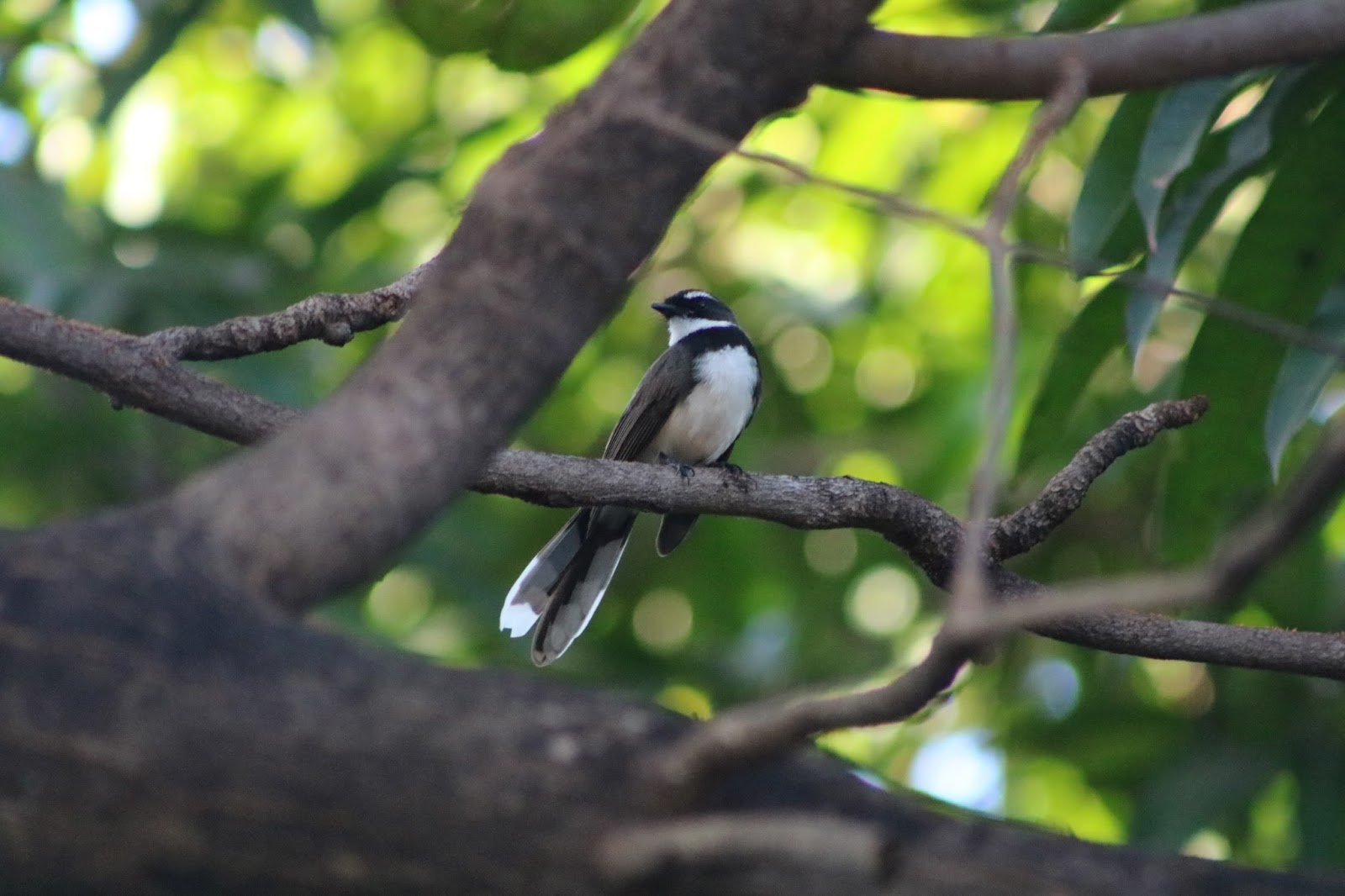
Pied fantail
The Pied fantail (Rhipidura nigritorquis) - This bird has been the first product of my bird photoshoot. Mostly, I see it flies together with eurasian tree sparrow. It is very visible in the morning because of it's fan-shaped tail and black and white color combination. But to take photo of it is not just easy, as it is constantly moving, agressively attacking other birds, even the rat roaming on the tree branch. I just had a good timing to take a photo when it perched on the branch of Talisay tree.

Pied triller

The Pied Triller (Lalage nigra) - At first, I thought it was a "shrike" because of the black-stripe passing through it's eye. Then the pied (black and white) patterns on it's wing confirming that bird is definitely a Pied triller. However, very few than the Pied fantail.

Eurasian tree sparrow
The Eurasian tree sparrow (Passer montanus) - This is the most dominant bird I always seen everywhere on my backyard. They are mostly very busy in getting dried stem to build nest on neighbor’s external ceiling, and sometimes joining the roosters eating on ground.

Yellow-vented bulbul
The Yellow vented bulbul (Pycnonotus goiavier) - The most active among the birds I've seen during the quest. Very easy to recognise as they are mostly perches in inclined position, making it's yellow vent to be visible. They flies and hop everywhere in a cluster.

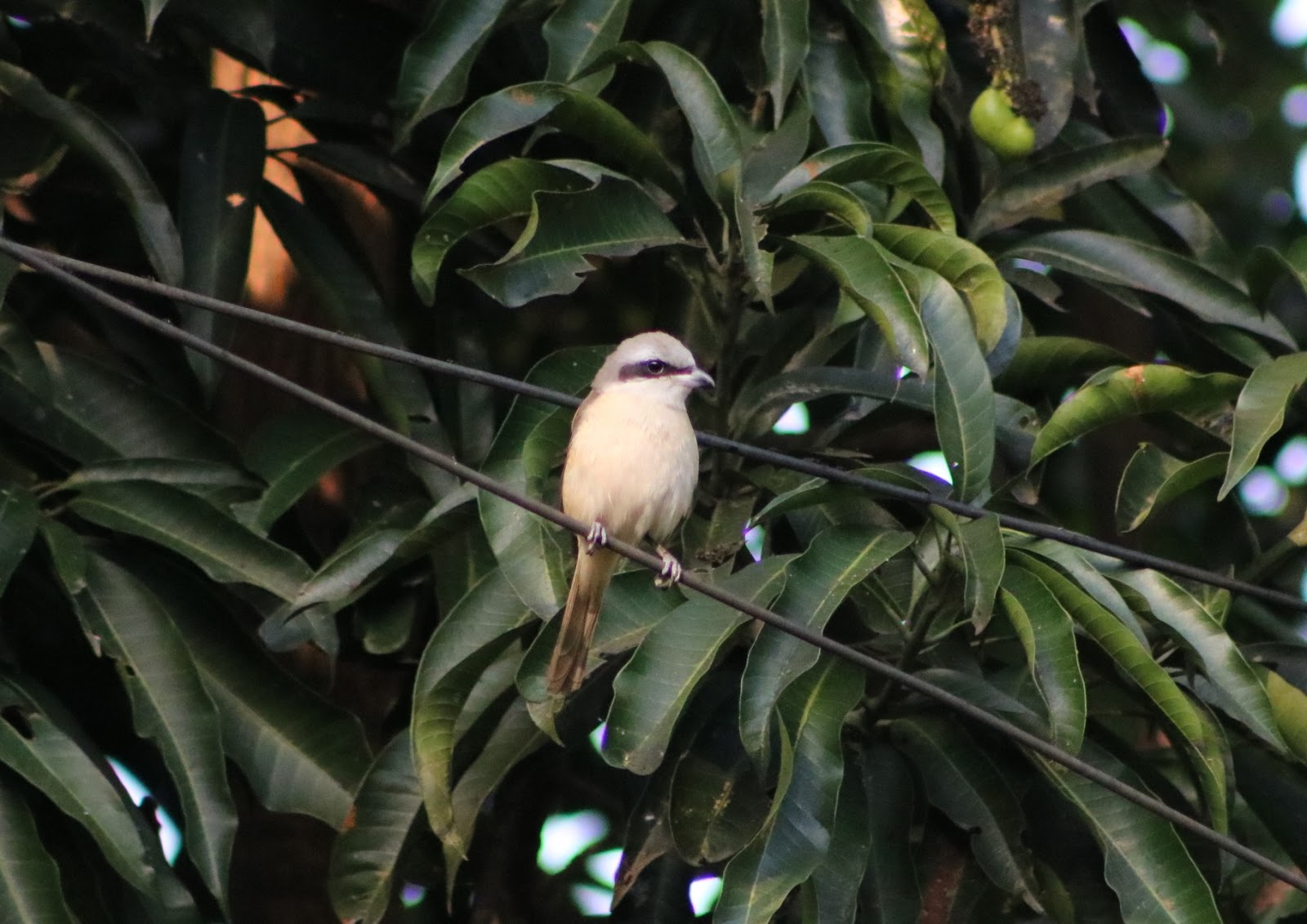
Brown shrike
The Brown shrike (Lanius cristatus) - Same as Eurasian tree sparrow; this bird species is very common on my backyard. They hop in different trees and very comfortable to perch on barbed wire, wall and cable.


Zebra dove
The Zebra dove (Geopelia striata) - It has an occasional appearance - mostly in pairs - when I conducted the photoshoot. Perches on a high spot and not too much moving, yet active in surveying the ground like a chicken.

Yellow-bellied sunbird
The Yellow-bellied sunbird - Though I'm unlucky to see again the Asian glossy starling and golden-bellied flyeater during my photoshoot, the presence of a Yellow-bellied sun bird which suddenly landed in tall Malunggay tree is a nice complementary.

Blurred Photo of Philippine Pigmy Woodpecker
The Philippine Pigmy Woodpecker (Dendrocopos maculatus) - The most intractable bird I saw during the photo-shoot. I seen it pecking the dried tree branch for only seconds and haven't had a clear shot. Though I regret, yet still thankful for this very surprising encounter. To see my backyard accommodating an endemic bird, is such a pleasant discovery!

Overall, I am pleased to finally document different kind of birds from my backyard. Hoping I could see again and take photo of their other breed I haven't yet include in the photo shoot. Very thankful to the Decathlon Philippines' Solognac 8x42 500 serie Binoculars! This tool exposed me to the idea of enjoyable wildlife discovery without living my comfort zone and left high importance to my "birding eyes", in learning to identify the birds. For sure, I'm gonna bring out this optic again; to check out new birds encounter on my backyard or try it for a longer birding quest in the future.


Friday, October 27, 2017

SNEAK PEEK BEYOND THE REACH OF SIGHT - Part I: “Lake Viewing with Binoculars”

LAKE VIEWING WITH SOLOGNAC 8X42 500 SERIE BINOCULARS
SNEAK PEEK BEYOND THE REACH OF SIGHT - Part I: “Lake Viewing with Binoculars
By: Ramon Q. Gayas Jr. (Ser Montaineer)

SOLOGNAC 8X42 500 SERIE BINOCULARS WITH HARNESS
On my recent outdoor trip, I had an opportunity to try out some of my merchandise from Wild Discovery Department, Decathlon Philippines Inc. These are the Solognac 8x42 500 serie Binoculars and Binoculars Harness. It is a privilege given to us by the company, to use our product outside the store for testing purposes. I haven't tried bringing this kind of instrument in my several years of doing outdoor activities. However, I am aware about the enjoyment it brings, as I enjoyed using binocs when I participated in a guided birding trip at UP Diliman last month, where I learned the basic binoculars adjustment and ways of responsible bird watching. That's why I felt this first product testing as a great opportunity, gave additional excitement knowing I would do it for Lake viewing at the Lake City of San Pablo, Laguna, which I quickly planned with my PNU-colleagues Heide Banday and Erl Lim for my 35th Birthday.

On October 14, 2017 around 08:00 in the morning at the very familiar Jollibee branch in San Pablo, I found myself speaking with tricycle driver named Pablo Lauigan, arranging trike service in order to visit the available eco-tourists Lake in the vicinity. Though a bit pricey which costs P700, I grabbed his offer considering that we're still affected by the bad weather made by typhoon Odette and to look for other driver might be time consuming.

GLOOMY MORNING AT LAKE SAMPALOC
Our trike ride started at 0830 AM and we fastly arrived at our first target, in Lake Sampaloc. Unfortunately, it was very gloomy and rainy that time, I am unable to use the binoculars during the time we are in Sampaloc. However, I found the place nice for tree walk and birding activity. I saw some birds - mostly Eurasian tree sparrow and Shrikes - and some common Philippine Native Trees like Narra (pterocarpus indicus) Talisay (terminalia catappa) and Acacia confusa. Interestingly, the 4 KM road encompassing the biggest Lake of San Pablo is apparently potential for running and walking, as one of my companion - Erl - had tried surveying it before. Then, by the time we are preparing to leave Sampaloc, the rain has slowly stop. So I took this moment to prepare the harness and binocs for our next viewing.

Continuing on to the next lake, we had reached Lake Mohicap at around 0945 AM. After paying the registration fee (P10), we directly proceed to the marker for photo opt and descended the 105 steps downstream. Upon reaching the lake's shore, the caretaker warmly welcomed us and gave some information about the place.

THE LAKE MOHICAP AND IMOC HILLS
Thereafter, we started to indulge the surroundings. The place looks refreshing, showcases greeneries and impressive view of notable landscape known as Imoc Hill. On the other hand, by the time I started using the Solognac Binoculars there, I enjoyed seeing the vegetation literally magnified, even the occasional raindrops, as if I'm closed to the features I am looking at. I can also easily adjust the binocs to clearly see every object I am spotting. While the Solognac Binoculars Harness is elastic, very manageable to use combined with the binocs. It makes me roamed freely, enables me to descend the shore, go up and down and go over the bamboo raft to get spotting position without requiring my hands to hold the optics. The harness securely compressed and hanged it on my chest. Furthermore, through using the Solognac Binoculars I was luckily spotted one of the bird species in the Lake, the Barn Swallow (hirundo rustica) locally known as "Layang layang", flying above us, chirping, playing and landed several times near to our standpoint.

AT THE MARKER
DESCENDING THE 105 STEPS
It was past 10:00 AM when we left Lake Mohicap, aiming to visit the other lake next to it, the Lake Palakpakin. Short trike ride after, the driver dropped us at one small bridge. At this point, Mang Pablo told us that bridge is the only way to see the Lake Palakpakin. Since, there is no other access to get closer we only took short sightseeing then headed to Lake Pandin. Even though we are notified by the caretaker in Mohicap that Pandin is close to visitors due to right of way issue.

THE RANCH AND VIEW OF MT. BANAHAW-CRISTOBAL
On the way to Lake Pandin, our venture commence at one community. One young boy - I named "Utoy" - approached us and offers a guide service, gave guarantee that there is a newly opened trail to reach Pandin. But I respectfully refused, hoping I could still track the landmark I've passed through when I visited the place as side trip of my Mt. Mabilog climb way back year 2011. However, many changes happened in the past six years. Infact, I got confused during the trek, but thankful that Utoy still following us when I did back trail. Then, I accepted his offer to guide us. Our trek resume at the ranch that is temporarily opened for Pandin visitors. This place is surprisingly beautiful; gave us way to see some cows roaming at the green grassy slopes, glimpse the views of Mt. Banahaw-Cristobal complex as well as Mt. Malarayat range. Though slightly rainy, muddy and slippery, we managed the trek to Lake Pandin within 20 minutes. Longer than the usual trekking time from the old trail, yet definitely more scenic.

AT LAKE PANDIN
At the Lake Pandin, we've been closer to the lake through our rented bamboo raft. The "bankeros" brought us to the opposite shore then we ate the food they served such as; grilled tilapia, okoy na hipon and fern ensalada. There, we are treated to witnessed the emerald green water section of the lake, we saw many small fishes they dubbed as "ayungin", joyfully tried the man-made swing, took photos, behold the refreshing air and the beautiful surroundings. I also had fun to spot the things behind us using the Solognac Binoculars. I saw some butterflies mostly white and yellow, birds like Grey Heron (ardea cinerea) and group of White Herons (ardea alba) flock over the lake. There is also one interesting bird we can't identify. This is different from the mentioned birds as its bearing short tail and white feathers with black spots. Yet showing capabilities same as the other migratory birds, that is impressively flying, wading and eat fishes.

Visiting Pandin is our main plan and we're glad to make it despite of weather disturbance. Though, we're not able to conquer the other Lakes (Yambo, Bunot and Calibato), Pandin experience rewarded us an exciting finale. Bringing all the good vibes and learnings from the lake viewing we had, we decided to leave the place by 3pm, and safely headed back to Manila.

Overall, bringing binoculars in my outdoor trip gave additional weight on my backpack. It cannot record the moment and sceneries we had at the Lake we've visited unlike the camera. Yet it has no charging requirement and I enjoyed using it to the fullest. Moreover, it gives considerable importance to me in seeing features from outdoor beyond the reach of my normal sight. I will surely not hesitate to use the Solognac Binoculars again and explore its diverse function in enjoying the great outdoors. Looking forward for Part II.

AT THE  FLOATING COTTAGE IN LAKE PANDIN
ENJOYING MAN-MADE SWING IN LAKE PANDIN
OUR FOOD IN LAKE PANDIN


Sunday, May 14, 2017

MANGROVE FOREST OF LOBO: "Wondering Walk through the Boardwalk of Lagadlarin"

THE BOARDWALK OF LAGADLARIN'S MANGROVE FOREST
MANGROVE FOREST OF LOBO
"Wondering Walk through the Boardwalk of Lagadlarin"
By: Ramon Q. Gayas Jr. (Ser Montaineer)

NOTE FROM THE BLOGGER: As we presently celebrates the Month of the Ocean, I dedicate this write up for wildlife's habitat that is very relevant to the sea, the Mangrove Forest. I wholeheartedly support that responsible use of mangrove forest in ecotourism is a great way to appreciate, nurture and preserve our beach forest, towards protecting the coastline and marine biodiversity, and strengthening our resilience to climate change.

OVERVIEW                                        

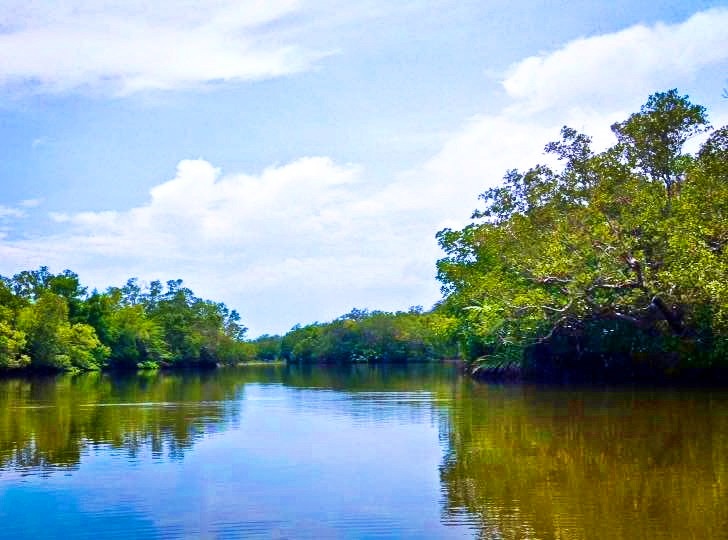
MANGROVE SWAMP
One cool stuff from the variety of adventures can be done once you set foot in the town of Lobo, Batangas is the trek through the “Boardwalk” of Brgy. Lagadlarin's Mangrove Forest. Formerly threatened with devastation, but folks are now eager to preserve this valuable wildlife's habitat as an Ecotourism site. A must visit attraction in Lobo which offers pleasant and enjoyable scenery. Just 20 minutes ride from the town proper and an easy 45 minutes to 1 hour boardwalk trekking, visitor enables for close-up mangrove forest experience.

TAKEN FROM OPEN TREE HOUSE
The trek through the boardwalk initially passing some Mangrove Palm trees (nipa fruticans), which eventually heading deeper to a wide bunch of Mangrove trees. You can glimpse to the "Mangrove Swamp" while passing - much closer from the bamboo bridge placed across - and might think for short, yet very potential "paddleboat tour". While climbing the man-made open "tree house" may give refreshment and makes you feels the ambiance atop the mangrove forest. Don't worry for the weariness, as there are established rest stop point in the area and a lot of photogenic spots ahead where you can stop by. More importantly, enjoy the surreal feelings from nature's sounds and being with it. All these are good for daylight tour and could be an extension of longer Lobo Batangas trip. Highly recommended!

ONE OF THE SEVERAL REST STOP POINT
OVERLAPPING BRANCHES OF MANGROVE TREE
PHOTO OPP SPOT AT THE END OF BOARDWALK
GROUP PICTURE ATOP THE OPEN TREE HOUSE COURTESY OF MS. RHONA
ADDITIONAL INFORMATION

Destination’s Profile
Major Jump-off: Brgy. Lagadlarin, Lobo, Batangas
Possible Duration: 1 to 2 hours Daylight tour
Features: Mangrove Forest, Swamp, Man-made Boardwalk, Open Tree House
Possible Activities: Boardwalk Trekking, Photo Opp, Potential for Paddleboat tour and Wildlife observation
Transportation
(As of May 06, 2017)
For commuters:

P157 - BUS - Manila to Batangas Grand Terminal Terminal (BCGT)
P20 – 2 JEEP - BCGT to Lobo Jeepney Terminal
P55 – JEEP – Lobo Jeepney Terminal to Lobo Poblacion
P60 – TRICYCLE – Poblacion to Lagadlarins Mangrove Forest

Last trip of Jeep from Lobo: 1700
Last trip of Bus from BCGT: 2000
                
For private transportation: Head out your trip to Batangas City Diversion Road via SLEX Star toll-way, take the road heading to Lobo Batangas. Afterwards, detour the ride to Brgy. Lagadlarin. Ask the local folk about parking area. Approximately 3.5 hours travel time from Buendia, Taft Avenue.

For tricycle and jeepney service from Lobo, Poblacion to Brgy. Lagadlarin: You may contact Romel Casilihan at 09077722052
Contacts and Coordination
Lobo Tourism Office: 09954960103
For Eco-tour you may contact Prof. Caringal at 09369365887
Registration and fees
Register at Pasalubong Center Lobo Poblacion and pay P20 Environmental users fee
Guide fee / Guide assistance
Not required

Water source
Available at the Jump-off community
Trekking notes and Precautions
Trend status – Presently gaining popularity, as of May 06, 2017

Prerequisite – Having knowledge about Mangrove ecosystem is an advantage

Daylight tour – Recommended

Night trekking – N/A

Cell phone signal – Sporadic in the entire boardwalk

Amount of water to bring – 1L for daylight tour

Sun exposure – In the afternoon, adjust your Itinerary

Wildlife encounter – Mostly birds and swamps’ small fishes
Campsite / Camping notes
N/A
Side Trip and Facilities
Beach at Lagadlarin

Shower area – At the Jump-off community

Sari-sari store  – At the Jump-off community
Estimated Budget
P600 (mangrove forest daylight tour for commuter)

SAMPLE ESTIMATED BUDGET COMPUTATION

(Mangrove Forest daylight tour for commuters from Manila, Make adjustment depends on your preference)

Number of participants
4 persons
Duration
Daylight tour
Transportation
P314 - BUS - Manila to Batangas City Grand Terminal (back and forth)

P150 – 3 JEEPNEY RIDES – Batangas City Grand Terminal to Lobo Poblacion (back and forth)

P30 per person – Tricycle service from Lobo, Poblacion to Brgy. Lagadlarin (back and forth)

Guide fee
N/A
Registration fee
P20
TOTAL
P600 (w/ P106 contingency fund)

SAMPLE ITINERARY

(Mangrove Forest daylight tour for commuters from Manila. Make adjustment depends on your preference)

0400 ETD Buendia Taft to Batangas City Grand Terminal
0530 ETA Batangas City Grand Terminal
0600 Take jeepney to Don Ramos
0615 ETA Don Ramos, take jeepney to Lobo Jeep Terminal
0630 ETA Lobo Jeep Terminal, take jeepney to Lobo Poblacion
0730 ETA Lobo Poblacion, Register at Pasalubong center, Breakfast
0800 Take tricycle to Lagadlarin Mangrove Forest
0820 ETA Lagadlarin Mangrove Forest, explore and take photo
1000 Optional side trip to Lagadlarin Beach, then headback to manila